
How to Generate Website Leads: Proven Strategies That Convert Traffic Into Revenue
Your website gets 10,000 visitors a month and produces 14 leads. I know because I audited a SaaS company's site with exactly those numbers, and the founder couldn't understand why paid campaigns weren't "working." The campaigns were fine. The site was a conversion desert.
How to Generate Website Leads: Proven Strategies That Convert Traffic Into Revenue
Your website gets 10,000 visitors a month and produces 14 leads. I know because I audited a SaaS company's site with exactly those numbers, and the founder couldn't understand why paid campaigns weren't "working." The campaigns were fine. The site was a conversion desert. No clear calls to action, a contact form buried three clicks deep, and zero reason for anyone to hand over their email. We fixed seven things. Within 90 days, that same traffic produced 340 leads per month. Not by buying more clicks, but by actually giving visitors a path to say yes.
The gap between traffic and revenue isn't a traffic problem. It's a lead capture problem. And most businesses are bleeding opportunity because they treat their website like a digital brochure instead of what it should be: a machine that turns strangers into prospects.
Here's what actually works to generate website leads, based on what I've built, broken, and rebuilt across dozens of client sites.
Stop Sending Traffic to Your Homepage
This is the single most expensive mistake in lead generation, and I see it constantly across B2B lead generation campaigns. You spend real money driving clicks from Google Ads, LinkedIn, or email campaigns, and where do those clicks land? Your homepage. A page designed to do everything for everyone, which means it converts almost nobody.
Every campaign needs a dedicated landing page with one job: get the visitor to take one specific action. That's it. One headline that matches the ad they clicked. One value proposition. One call to action. No navigation bar tempting them to wander off to your "About Us" page.
The math is simple. When there's a single option on the page, visitors are more likely to take it. When there are 15 links competing for attention, conversion rates crater. I've seen landing page conversion rates jump from 2% to 11% just by removing the top navigation and trimming the page to a single, focused offer.
Lead Magnets That People Actually Want
The phrase "lead magnets" gets thrown around a lot, but most of them are garbage. A 40-page ebook that nobody reads. A "free consultation" that sounds like a sales call. A newsletter signup with no stated benefit. These don't work because they don't offer immediate, specific value.
The lead magnets that drive real conversion optimization share three traits:
They solve a narrow, specific problem your prospect has right now
They deliver value in under 5 minutes
They make the prospect think, "If the free stuff is this good, the paid product must be incredible"
What does this look like in practice? ROI calculators. Audit templates. Benchmark reports for their industry. A 3-minute video walkthrough showing how to fix a specific problem. Interactive quizzes that give personalized recommendations based on answers.
Static PDFs are dying. The companies I work with that have switched to interactive tools as their primary lead magnets are seeing 2-3x the opt-in rates compared to traditional downloadable content. When someone fills out a quiz or uses a calculator, they get something tailored to them. That exchange feels fair. A generic PDF does not.
Businesses that blog and produce strategic content consistently generate 67% more leads than those that don't. But the content has to connect to a capture mechanism. A great blog post with no next step is a missed opportunity. Every piece of content should have a contextually relevant offer attached to it.
The Trust Problem You're Ignoring
Here's something that doesn't get enough attention in lead generation strategies discussions: people don't trust your website. They just don't. You're one of 10 tabs open in their browser, and they've been burned by form submissions that led to aggressive sales calls and inbox spam.
So how do you earn enough trust to get someone's contact information?
Real faces. As Orbit Media's research highlights, every lead generation site should show pictures of real people, not stock photos. Your visitors want to know who's behind the company. Show your team. Show your office. Show your customers.
Social proof. 72% of consumers trust testimonials, and including them on landing pages directly improves conversion. But don't just dump a carousel of logos on your homepage. Place specific, relevant testimonials next to your lead capture forms. A quote from a real customer right beside the "Get Started" button does more work than a dedicated testimonials page ever could.
Personalized CTAs. Generic "Submit" buttons convert poorly. Personalized calls to action convert 42% more visitors than default ones. "Get My Free Audit" beats "Submit." "Show Me My Results" beats "Download." The language should mirror what the visitor actually gets.
And here's one that's often overlooked: show how you give back. Donation programs, volunteer efforts, community support. It sounds soft, but it scores genuine goodwill points. People prefer buying from companies that feel human.
Web Chat Is Your Most Underrated Lead Channel
I was skeptical about live chat for years. It felt like a support tool, not a sales tool. I was wrong.
Web chat is one of the most effective inbound lead generation tools you can deploy, especially when paired with smart routing. When a visitor lands on your pricing page and has a question, the difference between getting an answer in 8 seconds versus finding a contact form, filling it out, and waiting 24 hours for a reply is the difference between a lead and a lost visitor.
The key is intent-based triggering. Don't blast a chat popup the moment someone arrives. Instead, trigger it when behavior signals buying intent:
Visitor has been on the pricing page for 30+ seconds
Visitor has viewed three or more product pages in a session
Visitor scrolls to the bottom of a case study page
Visitor returns to the site for a second or third time
These contextual triggers feel helpful rather than intrusive. And when a chatbot can qualify the lead with 2-3 quick questions before handing off to a human, you get higher quality conversations and fewer wasted minutes for your sales team.
If your mobile experience is sluggish or your chat widget doesn't render properly on phones, you're losing a huge chunk of potential leads. We've written about why mobile performance directly impacts your conversion metrics, and it applies doubly to interactive elements like chat.
Forms: Less Is Literally More
Every additional form field you add costs you leads. This isn't opinion. It's math.
For top-of-funnel offers, ask for an email address. That's it. Maybe a first name if you want to personalize follow-up emails. Every field beyond that is friction, and friction kills conversion.
"But I need their company name, title, phone number, and budget range to qualify them!" I hear this constantly from sales teams. And I get it. But here's the thing: a lead you never capture is worth zero. A lead you capture with just an email can be progressively profiled over time through subsequent interactions. Second download? Ask for the company name. Third engagement? Ask for their role. You build the profile gradually instead of demanding everything upfront.
The exception is bottom-of-funnel forms where the visitor is requesting a demo or a quote. At that stage, they expect to provide more detail, and the higher intent justifies the higher friction. But for your blog sidebar signup? For your free tool? Keep it ruthlessly short.
Content Strategy That Feeds the Funnel
Producing content without a lead capture strategy is just publishing. You need content that maps to every stage of the buyer's awareness, with appropriate conversion mechanisms at each level.
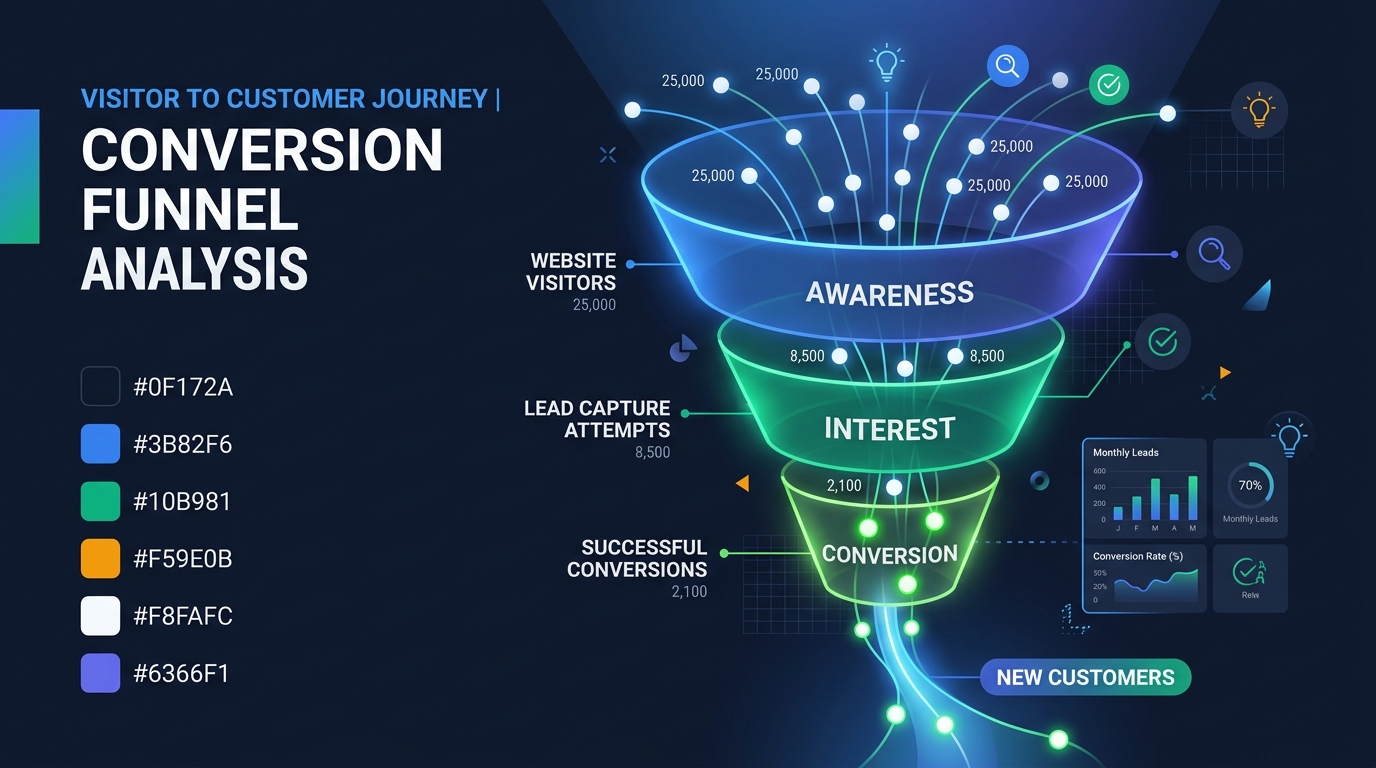
Top of funnel: Blog posts, industry benchmarks, how-to guides. These attract organic search traffic from people who don't know your product yet. The conversion mechanism here is a contextual lead magnet, a related resource offered inline or via exit-intent popup. The way SEO strategy continues to evolve with AI-driven recommendations means your content needs to answer specific questions thoroughly if you want to capture that organic traffic in the first place.
Middle of funnel: Comparison guides, case studies, webinars. Visitors at this stage know their problem and are evaluating solutions. The conversion mechanism is a free trial, demo request, or consultation offer.
Bottom of funnel: Pricing pages, ROI calculators, implementation guides. These visitors are close to a decision. The conversion mechanism is direct: talk to sales, start a trial, get a custom quote.
The mistake I see in most B2B lead generation programs is producing tons of top-of-funnel content with no middle or bottom layer. You end up with traffic that never converts because there's no next step that matches their growing intent.
SEO leads close at a rate of 14.6% compared to 1.7% for outbound leads. That gap should tell you where to invest. Inbound lead generation through organic content isn't just cheaper per lead. The leads are fundamentally better because the prospect came to you with an existing need.
The Data Layer Nobody Talks About
You can build beautiful landing pages, write killer content, and deploy smart chat widgets. But if your data is broken, you're optimizing blind. Duplicate records, misattributed leads, broken tracking pixels, and CRM hygiene issues silently erode your conversion rates and make every metric unreliable.
I've seen teams celebrate a "successful" campaign that generated 200 leads, only to discover that 60 of them were duplicates, 30 had invalid emails, and the attribution model was counting organic leads as paid. Understanding how bad data quietly destroys your marketing ROI is the unsexy prerequisite to every strategy in this article working properly.
Before you optimize your website conversion rates, make sure you can actually trust the numbers you're looking at.
The 30-Day Execution Plan
Strategy articles are useless without execution. Here's what I'd do if I inherited your site tomorrow:
Audit every page that gets more than 100 monthly visits and identify which ones have zero lead capture mechanism. Fix the top five first.
Build one high-value interactive lead magnet. A calculator, quiz, or assessment. Gate it behind an email-only form.
Install web chat with intent-based triggers on your pricing page, top 3 product pages, and top 5 blog posts by traffic.
Cut every form to the minimum viable fields. Progressive profiling handles the rest.
Place a specific, relevant testimonial with a real photo next to every primary CTA on your site.
Set up one automated email nurture sequence of 5-7 emails for new leads, segmented by the content they engaged with.
Review your tracking and CRM data for duplicates, broken attribution, and gaps before you declare any of this "working" or "not working."
None of these are theoretical. Every one of them has moved the needle for real businesses I've worked with. The compound effect of doing all seven in a focused 30-day sprint is what takes a site from "we get traffic but no leads" to "we can't respond to leads fast enough." That's the problem you want to have.

Sarah Chen
SEO strategist and web analytics expert with over 10 years of experience helping businesses improve their organic search visibility. Sarah covers keyword tracking, site audits, and data-driven growth strategies.
Frequently Asked Questions
- Why is my website getting traffic but not converting to leads?
- Most websites fail to convert traffic because they lack clear calls to action, have contact forms buried deep in navigation, and don't provide compelling reasons for visitors to share their email. The solution is treating your website as a lead capture machine rather than a digital brochure by implementing dedicated landing pages, lead magnets, and conversion mechanisms at every stage of the buyer journey.
- Should I send paid ad traffic to my homepage?
- No. Sending paid campaign traffic to your homepage is one of the most expensive mistakes in lead generation. Instead, create dedicated landing pages with one focused offer, a single headline matching the ad, one value proposition, and one call to action—eliminating navigation and competing links that reduce conversion rates.
- What makes an effective lead magnet?
- Effective lead magnets solve a narrow, specific problem, deliver value in under 5 minutes, and make prospects think the paid product must be excellent. Interactive tools like ROI calculators, quizzes, and audit templates generate 2-3x higher opt-in rates than static PDFs because they provide personalized, tailored value.
- How many form fields should I use to capture leads?
- For top-of-funnel offers, ask only for an email address—maybe a first name if you want personalization. Every additional field adds friction and costs you leads. You can progressively profile contacts through subsequent interactions rather than demanding all information upfront.
- How effective is live chat for lead generation?
- Web chat is one of the most underrated inbound lead generation tools available. The key is using intent-based triggering—displaying chat when visitors view pricing pages, multiple product pages, or return to your site—making it helpful rather than intrusive while qualifying leads before human handoff.
- What content should I create to generate leads at different stages?
- Create top-of-funnel content like blog posts and how-to guides with contextual lead magnets, middle-funnel content like case studies and webinars offering demos or consultations, and bottom-funnel content like pricing pages with direct sales offers. SEO-driven leads close at 14.6% compared to 1.7% for outbound leads, making organic content a high-ROI investment.
- What should I include on my landing pages to build trust?
- Include real photos of your team and customers instead of stock photos, place specific customer testimonials next to your lead capture forms, use personalized calls-to-action like 'Get My Free Audit' instead of generic 'Submit' buttons, and highlight community involvement or donation programs to signal that your company is human and trustworthy.
- How do I know if my lead generation data is reliable?
- Before optimizing conversion rates, audit your CRM and tracking for duplicate records, invalid emails, broken tracking pixels, and incorrect attribution. Bad data silently erodes conversion metrics and makes every optimization decision unreliable—fix this foundation before trusting any campaign results.
Explore more topics